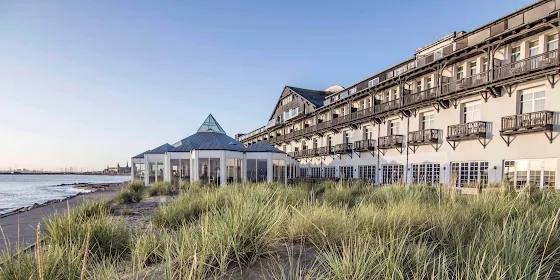
Denmark is home to many wonderful seaside hotels, where ocean views, relaxation and charming surroundings go hand in hand. But where can you find Denmark's Best Seaside Hotel? Is it at a traditional seaside hotel full of historic charm, a modern hotel with luxurious facilities or a small, hidden gem with a truly special atmosphere?
At OpdagDanmark, we celebrate the country's best seaside hotels and give people across Denmark the opportunity to vote for their favourites. Whether you dream of long walks along the beach, exceptional dining experiences or a relaxing getaway overlooking the sea, you can help discover the best seaside hotels in Denmark.
Just like on X Factor, you can vote for your favourite seaside hotel by text or through our app and help decide who takes home the title of Denmark's Best Seaside Hotel! We crown both a national winner and the best seaside hotels in Denmark's regions and four largest cities.
Find your favourite seaside hotel on the list or nominate one that's missing.
Cast your vote and share the competition with friends and family.
Follow the results and see who wins the title of Denmark's Best Seaside Hotel!
Every year, we announce the winners before the summer season gets into full swing, helping you find inspiration for your next getaway along the Danish coast.
2026
Finished 13 – 20 May
Denmark's Best Seaside Hotel 2026
In 2026, we've once again been on the hunt for Denmark's best seaside hotels – from traditional seaside hotels with historic charm and beautiful sea views to modern coastal gems that impress with exceptional dining, relaxation and a truly special atmosphere.
The competition returned for its ninth edition and voting is now closed! A big thank you to everyone who nominated and voted for their favourites, helping us celebrate the seaside hotels that create unforgettable experiences along Denmark's beautiful coastline.
Discover the winners of Denmark's Best Seaside Hotel 2026 and find inspiration for your next getaway along the Danish coast!
The result
1placeDenmark's Best Seaside HotelMelsted BadehotelGudhjem
2Hotel StrandlySkagen
3Badehotellet Grenaa Strand
Regions
NordjyllandNo. 2 in DenmarkHotel Strandly, Skagen
MidtjyllandNo. 3 in DenmarkBadehotellet Grenaa Strand
SydjyllandAarøsund Badehotel, Haderslev
Fyn & ØerLunds Hotel, Bogense
Sjælland & ØerNo. 1 in DenmarkMelsted Badehotel, Gudhjem
Ended May 20 at 01:00 PM
1
Melsted Badehotel, Gudhjem
2
Hotel Strandly, Skagen
3
Badehotellet Grenaa Strand
4
Bandholm Badehotel
5
Rødvig Kro og Badehotel
6
Aalbæk Badehotel
7
Hotel Bretagne Badehotel, Hornbæk
8
Hages Badehotel, Rødby
9
Aarøsund Badehotel, Haderslev
10
Strandhotel Klitrosen, Fjerritslev
11
Strandhotellet Sandvig, Allinge
12
Allinge Badehotel
12
Samsø Badehotel
14
Henne Mølle Å Badehotel
14
Lunds Hotel, Bogense
14
Plesner Badehotel, Skagen
17
Dyvig Badehotel, Nordborg
17
Gilleleje Badehotel
17
Knudhule Badehotel, Ry
20
Helenekilde Badehotel, Tisvildeleje
20
Hotel Strandlyst Badehotel
20
Kallehavegaard Badehotel, Løkken
20
Kellers Badehotel, Fanø
20
Lundsgaard Gods Badehotel, Kerteminde
20
Marienlyst Strandhotel, Helsingør
2025
Finished 16 – 23 April
The result
1placeDenmark's Best Seaside HotelHotel StrandlySkagen
2Henne Mølle Å Badehotel
3Melsted BadehotelGudhjem
Regions
FynLunds Hotel, Bogense
MidtjyllandSamsø Badehotel
NordjyllandNo. 1 in DenmarkHotel Strandly, Skagen
SjællandNo. 3 in DenmarkMelsted Badehotel, Gudhjem
The first seaside guesthouses appeared in Denmark in the late 19th century. This was when the upper middle class began taking holidays, and for Copenhagen's wealthier residents, a trip to Frederiksberg (which was considered countryside at the time) was no longer quite fashionable enough.
As doctors began prescribing fresh air and sea bathing as treatments for various illnesses, it became increasingly popular among Copenhagen's wealthy families to bring their servants along and spend the summer at country estates or coastal residences.
A brochure from 1912 titled “Skagen Badehotel paa Grenen – Danmarks Sundhedskilde” (Skagen Seaside Hotel at Grenen – Denmark's Source of Health) included the following description:
»Man springer ud af Sengen, gaar hen til Vinduet og slaar det op! Luften fra Havet stømmer ind saa morgenfrisk og salt, at man formentlig kan mærke det paa Tungen, naar man slikker sig om Munden.«
English translation of the original Danish quote:
“You leap out of bed, walk over to the window and throw it open! The sea air rushes in, so fresh and salty in the morning that you can almost taste it on your tongue when you lick your lips.”
Back then, the brochure did much the same as the popular Danish TV series Badehotellet does today – inspiring us to dream of a simpler life filled with relaxation and well-being by the sea.
Perhaps that's also why you've found your way to this page. But where can you still experience a traditional Danish seaside holiday at a hotel right by the water? Of course, you could choose one of the expensive hotels, but the truth is that since TV 2's hit series took Denmark by storm, countless hotels have added the word “bade” (seaside) to their names or descriptions.
The First Seaside Guesthouses
Fanø Vesterhavsbad opened in the early 1890s as Denmark's first dedicated spa and seaside guesthouse.
The spa hotel experienced a turbulent history with several changes of ownership after the war before it was eventually demolished in 1989.
Another of Denmark's earliest seaside guesthouses was Skagen Badehotel, which welcomed its first guests in 1898. It was among the country's largest and most prestigious seaside hotels, attracting royalty, influential figures and wealthy visitors from Denmark and abroad.
The idyllic hotel at Grenen, the northernmost tip of Skagen, is pictured below in 1912. Tragically, the hotel was destroyed by a fire caused by a lightning strike in 1938. Read more about the fire at Skagen Badehotel.
The Danish Holiday Act of 1938
Initially, holidays were a luxury reserved for the rich and wealthy. However, industrialisation in the late 19th century gradually created a clearer distinction between work and leisure.
Together with the introduction of restrictions on Sunday work in 1891, this helped encourage the development of Denmark's allotment garden movement. Over time, the concept of the weekend also became part of Danish life.
In 1938, Denmark introduced its first Holiday Act, granting employees the right to paid leave. In 1939, the law entitled workers to nine days of paid holiday, increasing to an impressive 12 days in 1940!
Today, the Danish Holiday Act guarantees five weeks of paid annual leave, while many employees are entitled to a sixth week through collective bargaining agreements.
Places in this category
Straight from the platform — not a result, but the field being voted on.